
A Look at Lectionaries
If the Jews used a lectionary to remind them of the significance of where they were in the Jewish calendar, then it's only natural that Christians would do the same with the Christian calendar.

Introduction
Most preachers that I interact with on a regular basis don't typically use the lectionary to plan out their sermons. I will typically look at it for seasons like Advent or Lent, but I usually preach through a book of the Bible or systematically preach through a topic. However, I know some preachers who are attached to the lectionary to the point that they are getting bored with it.
They have sermons for every text over the course of the three-year cycle, and they need something else so they can keep flexing their sermon prep muscles. According to Sarah Hinlicky Wilson, "The lectionary is the reason why if you’re a preacher, you’re bored to tears, and if you’re a layperson, you have a sneaking suspicion you’ve heard this one before." If that resonates with you, then I have good news for you! There are other lectionaries that you can borrow from!
Typically, when one thinks of the lectionary, they think of the Revised Common Lectionary since that is the most common one in use among mainline evangelical Protestants (and we will cover that one for our low-church friends). However, did you know that there are actually a handful out there that you can use?
Getting the Lingo Down
For those of you who may be eavesdropping on the conversation, you may be wondering, "What in the heck is a lectionary anyway?"
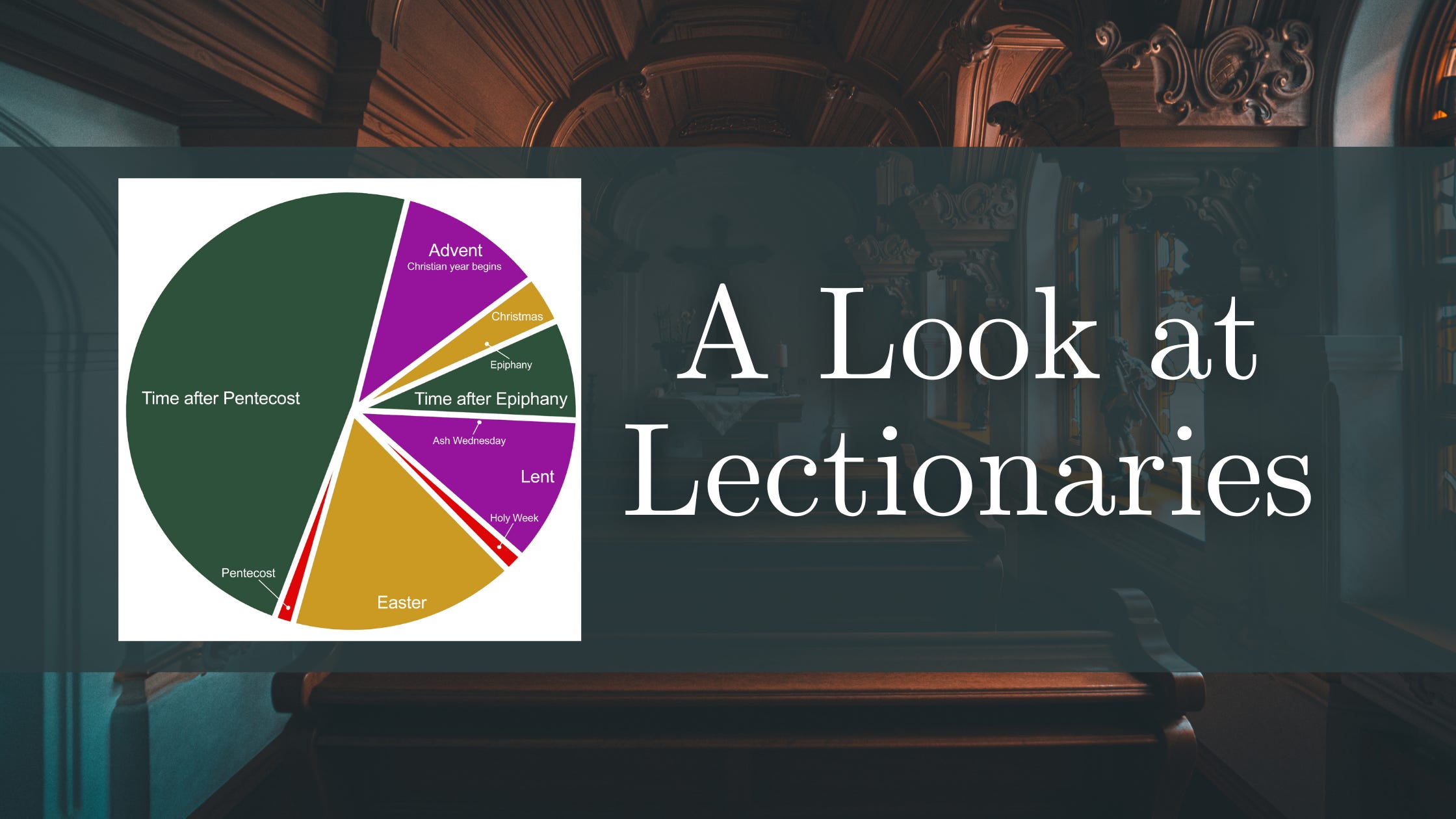
A lectionary is a systematic reading of selected Scriptures throughout the Christian year (Advent through Christ the King Sunday). The tradition of using a lectionary goes back to at least first-century Judaism (maybe even farther back than that), where there would be assigned readings from the Old Testament to address where the people of God were in the Jewish calendar. (You can read Leon Morris' extensive work on the Jewish lectionaries here.)
Even in Luke 4, when Jesus teaches in his hometown, the text tells us that they handed the scroll of Isaiah to Him so He could read from it. From this, we can infer that when Jesus read Isaiah 61 and said, "Today, this has been fulfilled in your hearing" (Luke 4:17-21), it was because Isaiah 61 was the assigned text for that Sabbath day.
So, if the Jews used a lectionary to remind them of the significance of where they were in the Jewish calendar, then it's only natural that Christians would do the same with the Christian calendar.
Let's look at some lectionaries at our disposal. This is by no means an exhaustive list. These are just some that I've found helpful.
The Revised Common Lectionary
The Common Lectionary was published in 1983 out of an ecumenical effort by both American and Canadian denominations to have a common experience of the story of Scripture throughout the Church year. There were various problems with its trial run, so the same people who brought us the Common Lectionary went back to the old drawing board and brought us the Revised Common Lectionary, which you can peruse at this link. The Revised Common Lectionary, published in 1992, takes into account constructive criticism of the Common Lectionary. It is a three-year cycle of Sunday Eucharistic readings in which Matthew, Mark, and Luke are read in successive years, and some material from John is read each year.
When a mainline church uses the lectionary, this is typically their go-to. Many PCUSA, Cumberland Presbyterian, United Methodist, and American Baptist congregations walk through this lectionary every three years.*
LCMS One-Year Lectionary
The Missouri Synod Lutheran Church developed the one-year lectionary, which you can view here. Admittedly, I don't know much about this lectionary, but from what I've seen, it could be handy for pastors who want to introduce the Christian calendar to congregations that have historically been a low church.
At this link, you can read a talk given by Rev. Randy Asburry, who gives some compelling reasons for using this lectionary.
The Narrative Lectionary
I have become quite familiar with the Narrative Lectionary over the last year or so. Basically, this lectionary operates on a four-year cycle where you focus on the story of one of the four gospels every year from Advent until Pentecost Sunday, and then there are various readings of Scripture throughout the rest of the church year that help us in examining other books of the Bible or systematically addressing different themes from Scripture.
I should add that one of the reasons I admire this particular lectionary is that it's convenient to take a break during Ordinary Time so that you can preach on other topics or books of the Bible that the lectionary doesn't cover.
You can read all about the Narrative Lectionary here.
The Heidelberg Catechism Lectionary
This catechism is unique for two reasons: first, it is designed to be used in conjunction with the Heidelberg Catechism. To my knowledge, no other lectionary is designed to work in this way. In this way, it can be used as both a preaching and discipleship tool. Second, it is based on the principle of lectio continua, or continuous reading and exposition of biblical books or parts of books.
According to the Faithward website, where the lectionary can be found,
This lectionary is the order of Scripture lessons, with suggestions for the use of questions and answers from the Heidelberg Catechism during the Season of Pentecost. In addition to the order and selections of the Psalter, this is a four-year plan for using the Bible as the basis for preaching the Word of God.
Lectionary from Christ Church - Moscow, Idaho
Even though I follow Christ Church and Douglas Wilson, I haven't heard much about their lectionary. From what I understand, this lectionary is strictly used for readings in the Sunday morning worship services at Christ Church (as opposed to being used for selections for sermon texts). However, when I began filling the pulpit at various Cumberland Presbyterian Churches in my presbytery, I found this lectionary helpful for selecting sermon texts.
Because of the limited readings in a two-year cycle, this might be perfect for any preacher who wants a personal challenge. You can find their lectionary here.
If you're a lectionary preacher, I hope you found this article helpful. Contact me if there are other lectionaries that I can address in future articles! Thanks!
As always, if you like what you’re reading and want to support my work, then you can follow me on all my socials and purchase my merch and books at this link. Thank you for taking the time to read what I have to say. I really appreciate it!